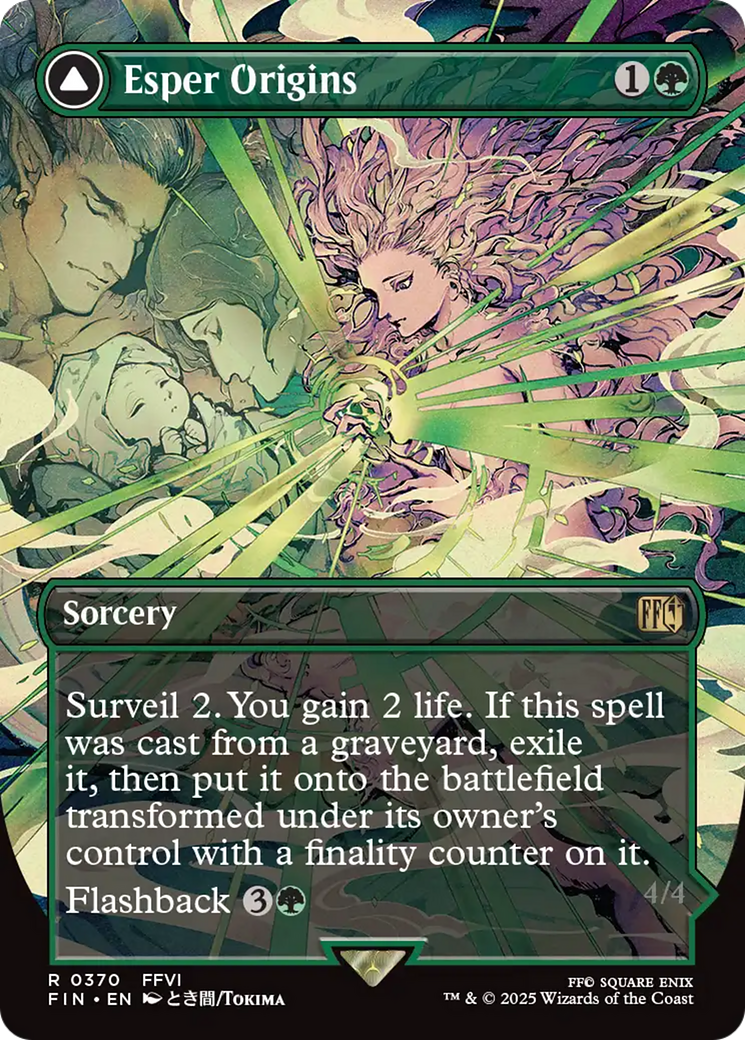

Esper Origins // Summon: Esper Maduin
I — Reveal the top card of your library. If it's a permanent card, put it into your hand.
II — Add {G}{G}.
III — Other creatures you control get +2/+2 and gain trample until end of turn.
| Finish | Market Price | Lowest Price | Highest Price | Average Price |
|---|---|---|---|---|
| Normal | $4.37 | $1.95 | $10.83 | $3.90 |
| Foil | $5.74 | $3.42 | $9.82 | $5.02 |
Alchemy | Brawl | ||
Commander | Duel | ||
Gladiator | Historic | ||
Legacy | Modern | ||
Oathbreaker | Pauper | ||
Pauper Commander | Penny | ||
Pioneer | Standard | ||
Timeless |
Finality counters don't stop permanents from going to zones other than the graveyard from the battlefield. For example, if a permanent with a finality counter on it would be put into its owner's hand from the battlefield, it does so normally.
Finality counters work on any permanent, not only creatures. If a permanent with a finality counter on it would be put into a graveyard from the battlefield, exile it instead.
If a card with flashback is put into your graveyard during your turn, you can cast it if it's legal to do so before any other player can take any actions.
If you are instructed to put a card that isn't a double-faced card onto the battlefield transformed, it will not enter at all. In that case, it stays in the zone it was previously in. For example, if a single-faced card is a copy of Crystal Fragments, it will be exiled during the resolution of its second ability and remain in exile.
In the Commander variant, a double-faced card's color identity is determined by the mana costs and mana symbols in the rules text of both faces combined. If either face has a color indicator or basic land type, those are also considered. For example, Cecil, Dark Knight's color identity is black and white, since its front face is black and its back face has a white color indicator.
Multiple finality counters on a single permanent are redundant.
Summon: Esper Maduin's second chapter ability isn't a mana ability. It uses the stack and can be responded to.
The back face of a nonmodal double-faced card usually has a color indicator that defines its color.
The mana value of a nonmodal double-faced card is the mana value of its front face, no matter which face is up.
To determine the total cost of a spell, start with the mana cost or alternative cost (such as a flashback cost) you're paying, add any cost increases, then apply any cost reductions. The mana value of the spell is determined only by its mana cost, no matter what the total cost to cast the spell was.
You can cast a spell using flashback even if it was somehow put into your graveyard without having been cast.
You must still follow any timing restrictions and permissions, including those based on the card's type. For instance, you can cast a sorcery using flashback only when you could normally cast a sorcery.
"Flashback [cost]" means "You may cast this card from your graveyard if the resulting spell is an instant or sorcery spell by paying [cost] rather than paying its mana cost" and "If the flashback cost was paid, exile this card instead of putting it anywhere else any time it would leave the stack."
A nonmodal double-faced card enters with its front face up by default, unless a spell or ability instructs you to put it onto the battlefield transformed or allows you to cast it transformed, in which case it enters with its back face up.
A sorcery can't be put onto the battlefield and a permanent can't transform into a sorcery. If an effect exiles Summon: Esper Maduin and then instructs you to return it to the battlefield, it remains face up in exile (unless that effect instructs you to put it onto the battlefield transformed, in which case it returns as Summon: Esper Maduin). If an effect instructs you to transform Summon: Esper Maduin, the instruction is ignored.
A spell cast using flashback will always be exiled afterward, whether it resolves, is countered, or leaves the stack in some other way.
A token that is created as a copy of a double-faced permanent or a double-faced card in another zone is a double-faced token. It will have both the front face and back face of whatever object it's copying. If it's copying a double-faced permanent whose back face is up, the token will enter with its back face up. It can transform if instructed to do so.
Each face of a nonmodal double-faced card has its own set of characteristics: name, types, subtypes, abilities, and so on. While a nonmodal double-faced permanent is on the battlefield, consider only the characteristics of the face that's currently up. The other set of characteristics is ignored.
Each nonmodal double-faced card in this release is cast face up. In every zone other than the battlefield, consider only the characteristics of its front face. If it is on the battlefield, consider only the characteristics of the face that's up; the other face's characteristics are ignored.
Finality counters aren't keyword counters, and a finality counter doesn't give any abilities to the permanent it's on. If that permanent loses its abilities and then would go to a graveyard, it will still be exiled instead.