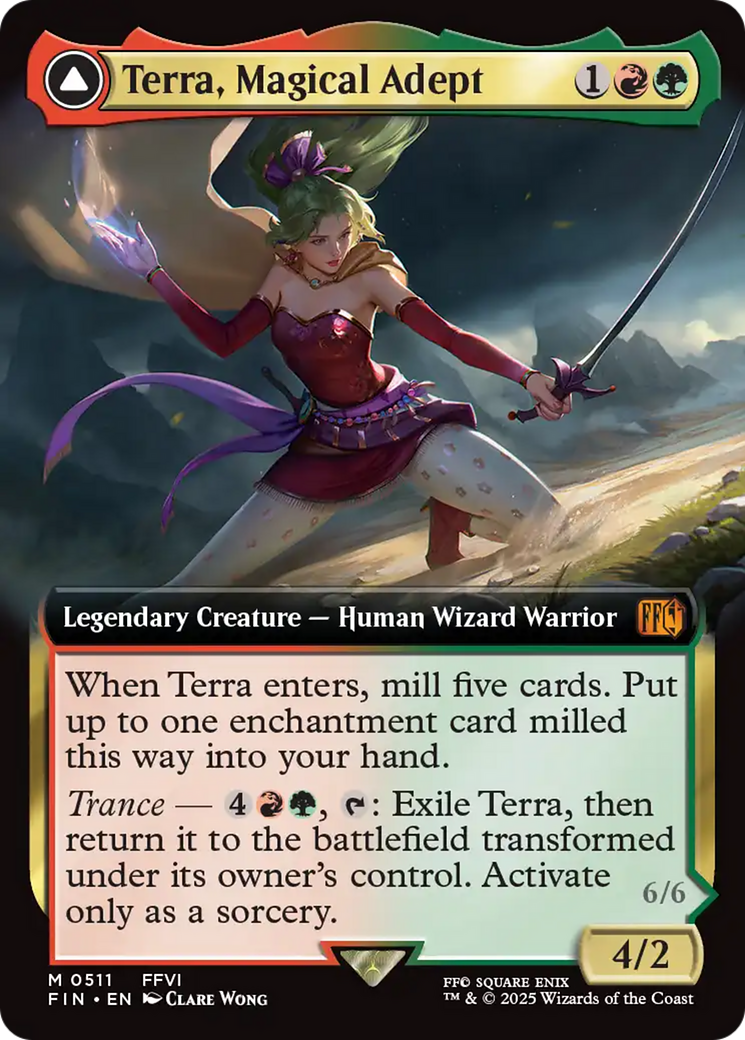
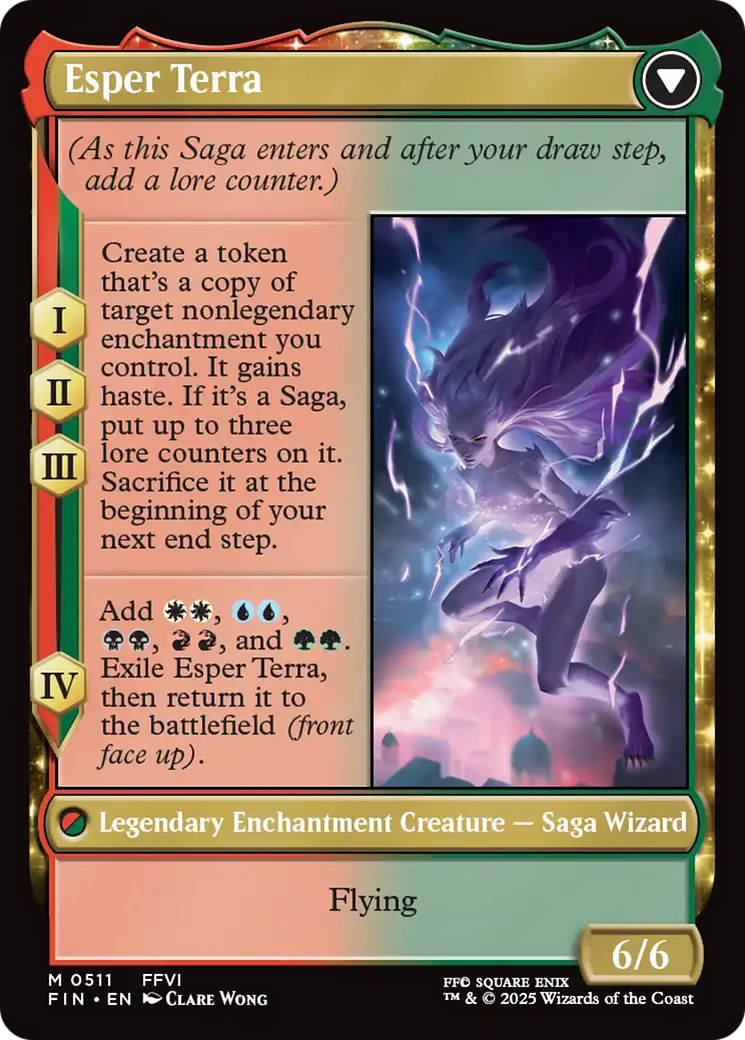
Terra, Magical Adept // Esper Terra
Trance — {4}{R}{G}, {T}: Exile Terra, then return it to the battlefield transformed under its owner's control. Activate only as a sorcery.
| Finish | Market Price | Lowest Price | Highest Price | Average Price |
|---|---|---|---|---|
| Normal | $13.23 | $9.96 | $47.99 | $14.04 |
| Foil | $38.79 | $26.39 | $128.52 | $35.30 |
Alchemy | Brawl | ||
Commander | Duel | ||
Gladiator | Historic | ||
Legacy | Modern | ||
Oathbreaker | Pauper | ||
Pauper Commander | Penny | ||
Pioneer | Standard | ||
Timeless |
A nonmodal double-faced card enters with its front face up by default, unless a spell or ability instructs you to put it onto the battlefield transformed or allows you to cast it transformed, in which case it enters with its back face up.
A token that is created as a copy of a double-faced permanent or a double-faced card in another zone is a double-faced token. It will have both the front face and back face of whatever object it's copying. If it's copying a double-faced permanent whose back face is up, the token will enter with its back face up. It can transform if instructed to do so.
Each face of a nonmodal double-faced card has its own set of characteristics: name, types, subtypes, abilities, and so on. While a nonmodal double-faced permanent is on the battlefield, consider only the characteristics of the face that's currently up. The other set of characteristics is ignored.
Each nonmodal double-faced card in this release is cast face up. In every zone other than the battlefield, consider only the characteristics of its front face. If it is on the battlefield, consider only the characteristics of the face that's up; the other face's characteristics are ignored.
Esper Terra's fourth chapter ability isn't a mana ability. It uses the stack and can be responded to.
If the copied enchantment has {X} in its mana cost, X is 0.
If the copied enchantment is a token, the new token that's created copies the original characteristics of that token as stated by the effect that created the token.
If the copied enchantment is copying something else, then the token enters as whatever that enchantment copied.
If the enchantment copied by the token had any "when [this permanent] enters" abilities, the token also has those abilities, and they'll trigger when it's created. Similarly, any "as [this permanent] enters" or "[this permanent] enters with" abilities that the token has copied will also work.
If you are instructed to put a card that isn't a double-faced card onto the battlefield transformed, it will not enter at all. In that case, it stays in the zone it was previously in. For example, if a single-faced card is a copy of Crystal Fragments, it will be exiled during the resolution of its second ability and remain in exile.
In the Commander variant, a double-faced card's color identity is determined by the mana costs and mana symbols in the rules text of both faces combined. If either face has a color indicator or basic land type, those are also considered. For example, Cecil, Dark Knight's color identity is black and white, since its front face is black and its back face has a white color indicator.
The back face of a nonmodal double-faced card usually has a color indicator that defines its color.
The mana value of a nonmodal double-faced card is the mana value of its front face, no matter which face is up.
The token copies exactly what was printed on the original enchantment (unless that enchantment is copying something else or is a token; see below). It doesn't copy whether that enchantment is tapped or untapped, whether it has any counters on it or any Auras or Equipment attached to it, or any non-copy effects that have changed its types, color, power and toughness, and so on.