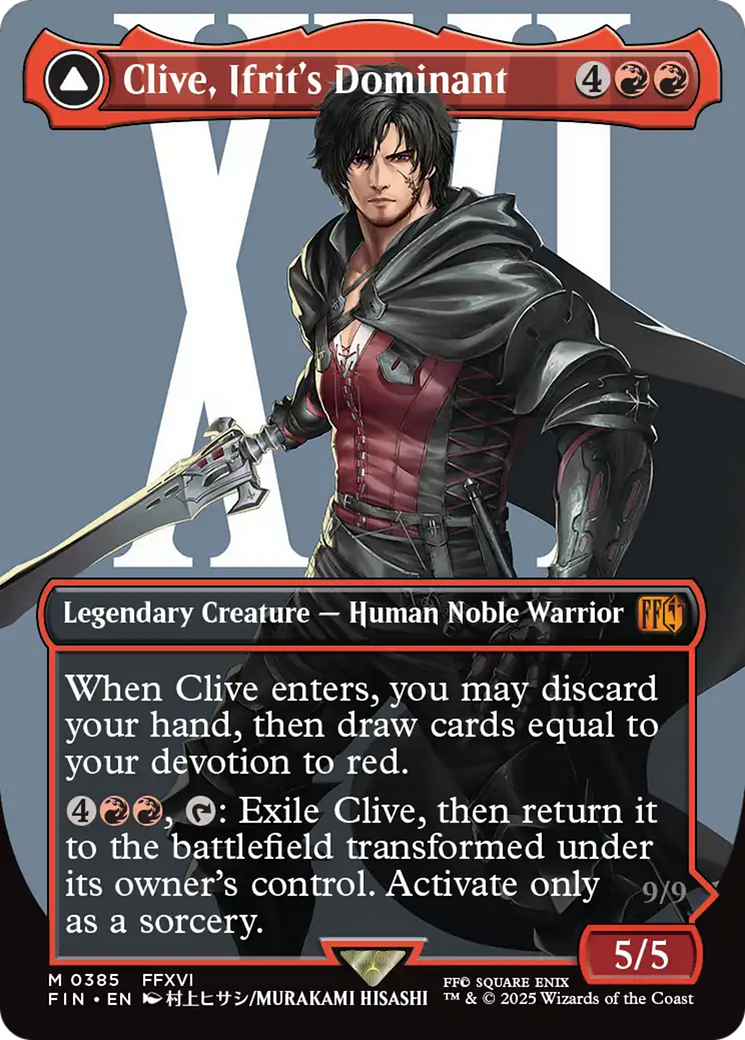
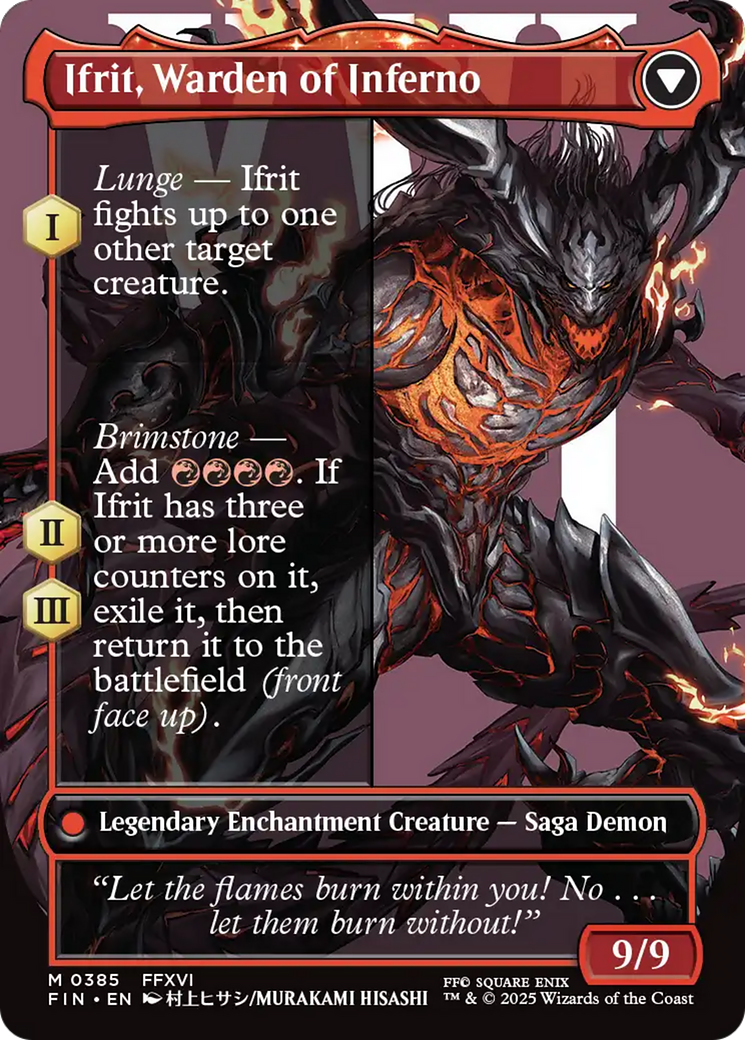
Clive, Ifrit's Dominant // Ifrit, Warden of Inferno
{4}{R}{R}, {T}: Exile Clive, then return it to the battlefield transformed under its owner's control. Activate only as a sorcery.
| Finish | Market Price | Lowest Price | Highest Price | Average Price |
|---|---|---|---|---|
| Normal | $11.61 | $7.86 | $65.92 | $12.78 |
| Foil | $14.26 | $9.67 | $34.28 | $13.48 |
Alchemy | Brawl | ||
Commander | Duel | ||
Gladiator | Historic | ||
Legacy | Modern | ||
Oathbreaker | Pauper | ||
Pauper Commander | Penny | ||
Pioneer | Standard | ||
Timeless |
"Hideaway N" means "When this permanent enters, look at the top N cards of your library. Exile one of them face down and put the rest on the bottom of your library in a random order. The exiled card gains ‘The player who controls the permanent that exiled this card may look at this card in the exile zone.'"
A nonmodal double-faced card enters with its front face up by default, unless a spell or ability instructs you to put it onto the battlefield transformed or allows you to cast it transformed, in which case it enters with its back face up.
A token that is created as a copy of a double-faced permanent or a double-faced card in another zone is a double-faced token. It will have both the front face and back face of whatever object it's copying. If it's copying a double-faced permanent whose back face is up, the token will enter with its back face up. It can transform if instructed to do so.
Any player who has controlled a permanent with a hideaway ability since a card was exiled with it may look at that card.
Clive's Hideaway's last ability only cares if you control four or more legendary creatures at the time it resolves. You don't even have to control four or more legendary creatures when you activate it.
Colorless and generic mana symbols ({C}, {0}, {1}, {2}, {X}, and so on) in mana costs of permanents you control don't count toward your devotion to any color.
Count the number of red mana symbols among the mana costs of permanents you control as Clive's triggered ability resolves to determine your devotion to red. If Clive is still on the battlefield at that time, it will be included in that count.
Each face of a nonmodal double-faced card has its own set of characteristics: name, types, subtypes, abilities, and so on. While a nonmodal double-faced permanent is on the battlefield, consider only the characteristics of the face that's currently up. The other set of characteristics is ignored.
Each nonmodal double-faced card in this release is cast face up. In every zone other than the battlefield, consider only the characteristics of its front face. If it is on the battlefield, consider only the characteristics of the face that's up; the other face's characteristics are ignored.
Hybrid mana symbols, monocolored hybrid mana symbols, and Phyrexian mana symbols do count toward your devotion to their color(s).
If a spell has {X} in its mana cost, you must choose 0 as the value of X when playing it without paying its mana cost.
If the exiled card is a land card, you may play it only if you have an available land play remaining this turn.
If you are instructed to put a card that isn't a double-faced card onto the battlefield transformed, it will not enter at all. In that case, it stays in the zone it was previously in. For example, if a single-faced card is a copy of Crystal Fragments, it will be exiled during the resolution of its second ability and remain in exile.
If you cast a spell "without paying its mana cost," you can't choose to cast it for any alternative costs. You can, however, pay additional costs. If the spell has any mandatory additional costs, those must be paid to cast the spell.
If you put an Aura on an opponent's permanent, you still control the Aura, and mana symbols in its mana cost count towards your devotion. Similarly, if you make an opponent the protector of a Siege you control, mana symbols in that battle's mana cost count toward your devotion.
In the Commander variant, a double-faced card's color identity is determined by the mana costs and mana symbols in the rules text of both faces combined. If either face has a color indicator or basic land type, those are also considered. For example, Cecil, Dark Knight's color identity is black and white, since its front face is black and its back face has a white color indicator.
Mana symbols in the text boxes of permanents you control don't count toward your devotion to any color.
The back face of a nonmodal double-faced card usually has a color indicator that defines its color.
The mana value of a nonmodal double-faced card is the mana value of its front face, no matter which face is up.
You may choose to discard your hand even if your hand contains zero cards.
You play the card while Clive's Hideaway's last ability is resolving and still on the stack. You can't wait to play it later in the turn.